

28
Sep
2026
Companies and taxation
2026
Companies and taxation
Moderating the Conference “Company law reform in Monaco (Law No. 1573): what impact on management?” in collaboration with the Monaco Economic Board and the Order of Chartered Accountants of Monaco
Photos © Sébastien Darasse
28 September 2026 (Novotel, Monaco)
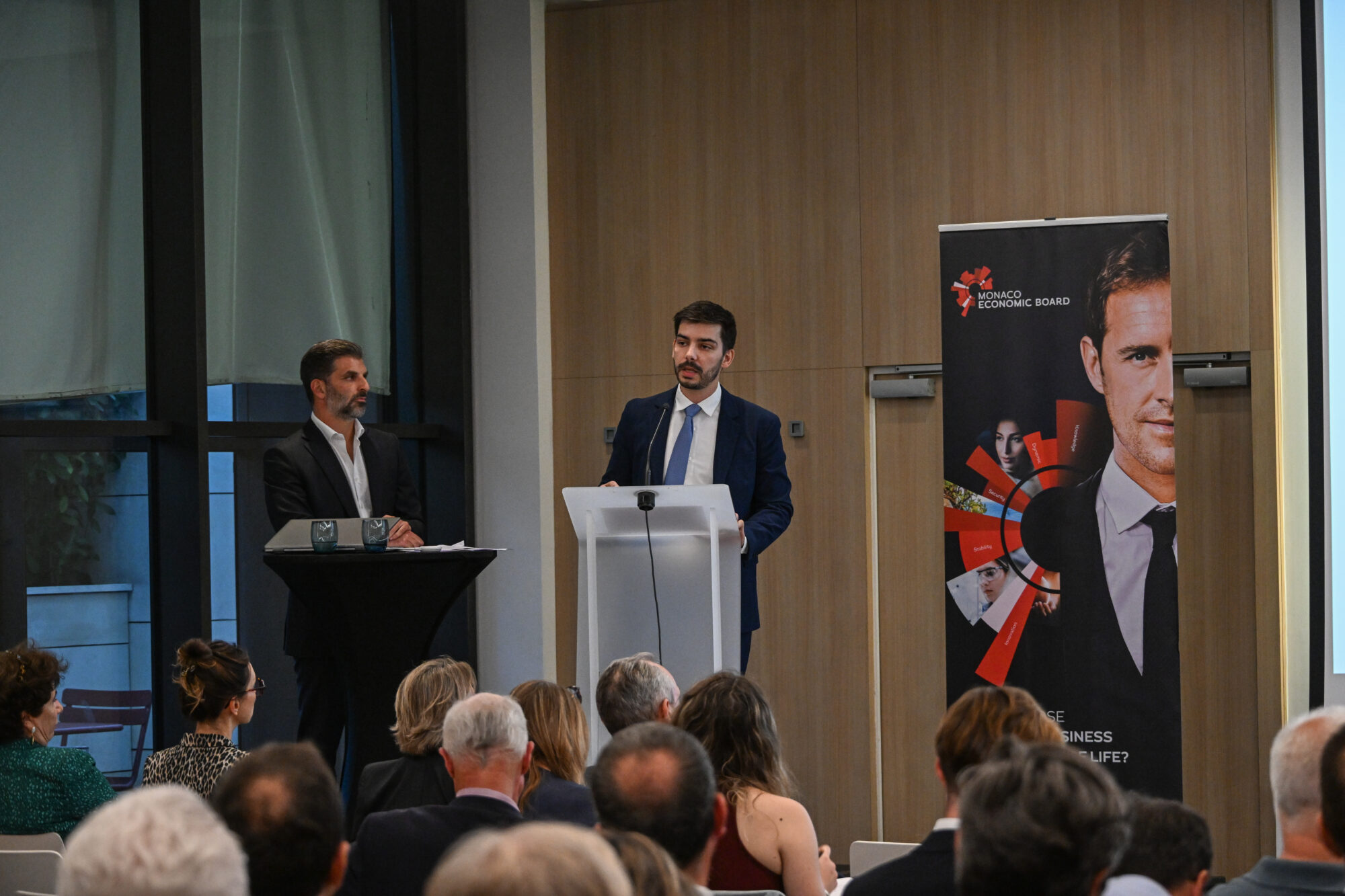
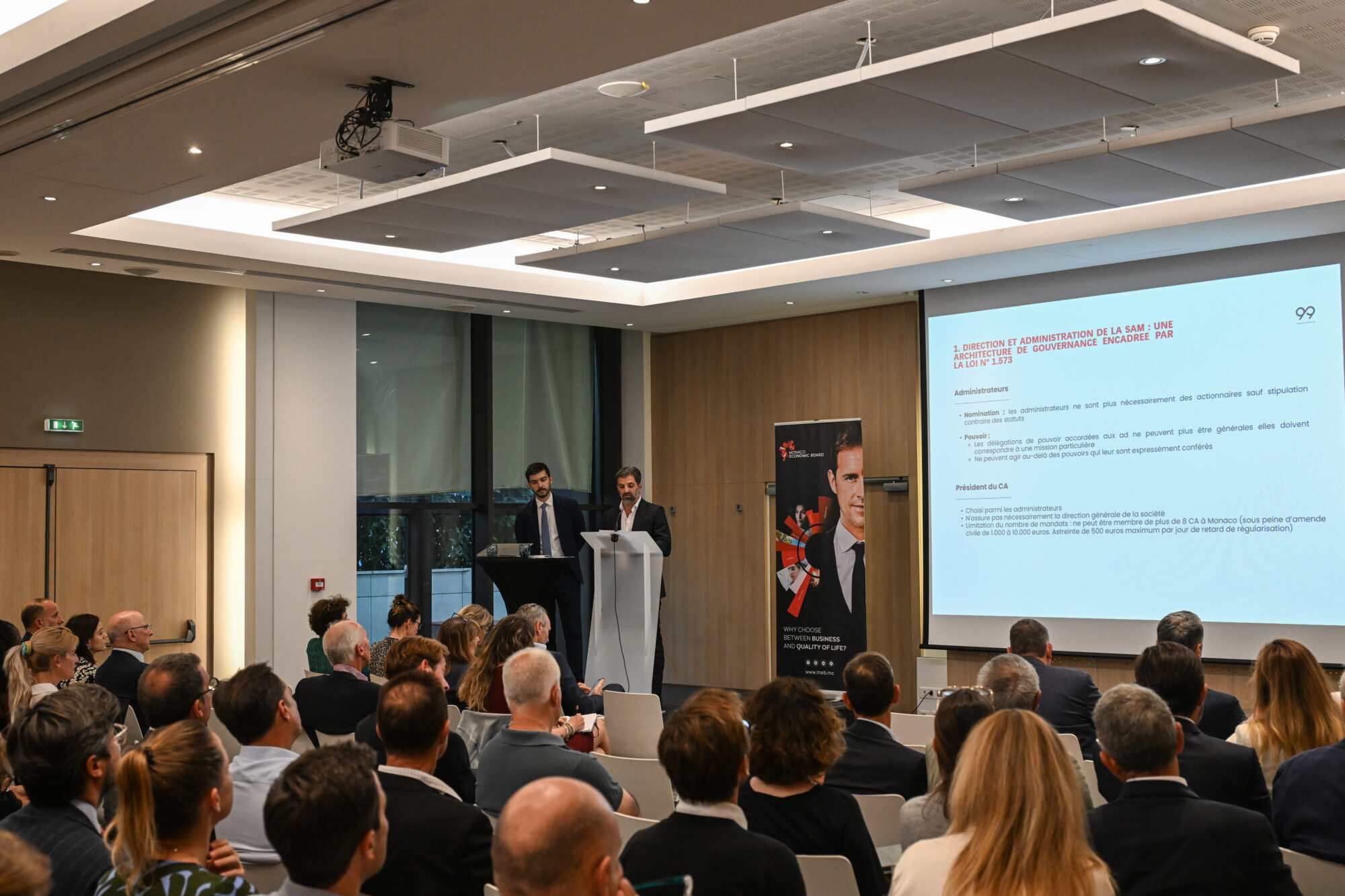
Grégoire GAMERDINGER, Lawyer Partner, and Victor BARDAWIL, Senior Associate in the Corporate and Tax Law Department at 99 AVOCATS ASSOCIÉS, led a Conference organised by the Monaco Economic Board (MEB, Chamber of commerce), in partnership with the Order of Chartered Accountants of Monaco, on the topic:
“Company law reform in Monaco (Law No. 1573): what impact on management?”
* * *
The following points were discussed:
1. Management and administration of the SAM (public limited company): a governance framework governed by Law No. 1573
Prior to the reform, the organisation of SAM governance relied largely on the articles of association and on functions shaped by practice, which could make the distribution of powers difficult for third parties to understand.
Law No. 1.573 defines the respective roles of the general meeting of shareholders ("Assemblée générale des actionnaires"), the board of directors ("conseil d’administration"), and senior management ("direction générale") (Articles 22 through 27 of Law No. 1,573).
Above all, it clarifies the structure of senior management at SAMs. Shareholders may choose whether or not to separate the functions of administration and management. Executive management may be exercised either by the chair of the board of directors (referred to as the "président directeur général (PDG)", "chairman and chief executive officer") or by another person (referred to as the "directeur général (DG)", "chief executive") (Articles 22 to 27 of Law No. 1.573).
2. The prevention of conflicts of interest and the oversight of governance in SAMs and SARLs (limited liability company)
Law No. 1.573 replaces a largely declaratory approach with a more stringent framework, based on the requirement for prior authorisation of certain agreements and an absolute prohibition on certain transactions.
In SAMs, the chair of the board of directors, the managing director or chief executive officer, executive directors and directors may not, on pain of nullity, acquire or retain a direct or indirect interest in a transaction entered into with the company or on its behalf without the prior authorisation of the board of directors (Article 44 of Law No. 1.573). A similar mechanism applies to non-partner managers of limited liability companies (SARLs), with authorisation in such cases being granted by the general meeting, in which the person concerned may not participate (Article 35-7 of the Commercial Code).
Certain transactions are, for their part, prohibited. These include, in particular, loans, overdrafts, guarantees or sureties granted by the company for the benefit of directors, certain partners or board members, their relatives or intermediaries. These prohibitions apply to both SAMs (Article 45 of Law No. 1.573) and SARLs (Article 35-9 of the Commercial Code).
At the same time, the rights of SAM shareholders and SARL partners have been strengthened (inclusion of items or draft resolutions on the agenda, written questions, and the right to raise the alarm regarding matters likely to jeopardise the continuity of operations).
3. Management responsibilities: directors and persons in charge of the management of SAMs and SARLs
"Administrateurs" (directors), legal representatives of SAMs (PDG/DG) and "gérants" (managers) of SARLs must exercise due diligence on several levels:
They may be held civilly liable to the company and its shareholders or members in the event of mismanagement, or a breach of the law or the articles of association. With regard to third parties, their personal liability generally requires a fault that is separate from their official duties, in particular an intentional fault or one of particular gravity.
In the event of insolvency proceedings, the PDG/DG of the SAM or the manager of the SARL may be ordered to bear all or part of the shortfall in assets where mismanagement has contributed to it. Depending on the circumstances, this order may be accompanied by a personal bankruptcy or a ban on directing, managing, administering or controlling a business or legal entity.
Criminal liability includes offences provided for under Law No. 1.573, sector-specific legislation and general law, in particular in relation to bankruptcy, breach of trust, forgery, money laundering, the distribution of fictitious dividends and the presentation of inaccurate accounts.
Law No. 1.573 supplements this framework by introducing new penalties corresponding to the new prohibitions or obligations (for example, the civil and criminal liability of the permanent representative of a legal person appointed as a director, Article 25 of Law No. 1.573), and by amending existing penalties (for example, offences relating to the unlawful issue and trading of shares or share coupons, Article 68 of Law No. 1.573; offences relating to the overvaluation of contributions in kind, the distribution of fictitious dividends, and the inaccurate publication or presentation of accounts, Article 69 of Law No. 1.573).
* * *
Publication on the MEB (Chamber of commerce) official Website:
Photos © Sébastien Darasse
Other articles