

13/
Mar
2026
2026
Legal news
Labour law
Key points regarding the mutual termination of a permanent employment contract (CDI) in Monaco
The Principality of Monaco has taken a new step forward in labour law with the entry into force of the contractual termination of permanent employment contracts (CDI), now available to employers and employees in the private sector.
Enacted by Law No. 1.583 of 2 December 2025, supplemented by Ministerial Order 2025-715 of 24 December 2025, this method of amicable termination of a permanent contract is in addition to dismissal and resignation and entitles the employee to specific compensation and the return-to-work allowance.
Although the scheme is based on French law, it is important to remain mindful of the specific features of Monegasque law.
NOTE FOR PROCEDURES: since 23 March 2026, an online service dedicated to the mutual termination of employment contracts has been available at Monguichet.mc > https://teleservice.gouv.mc/rupture-conventionnelle/
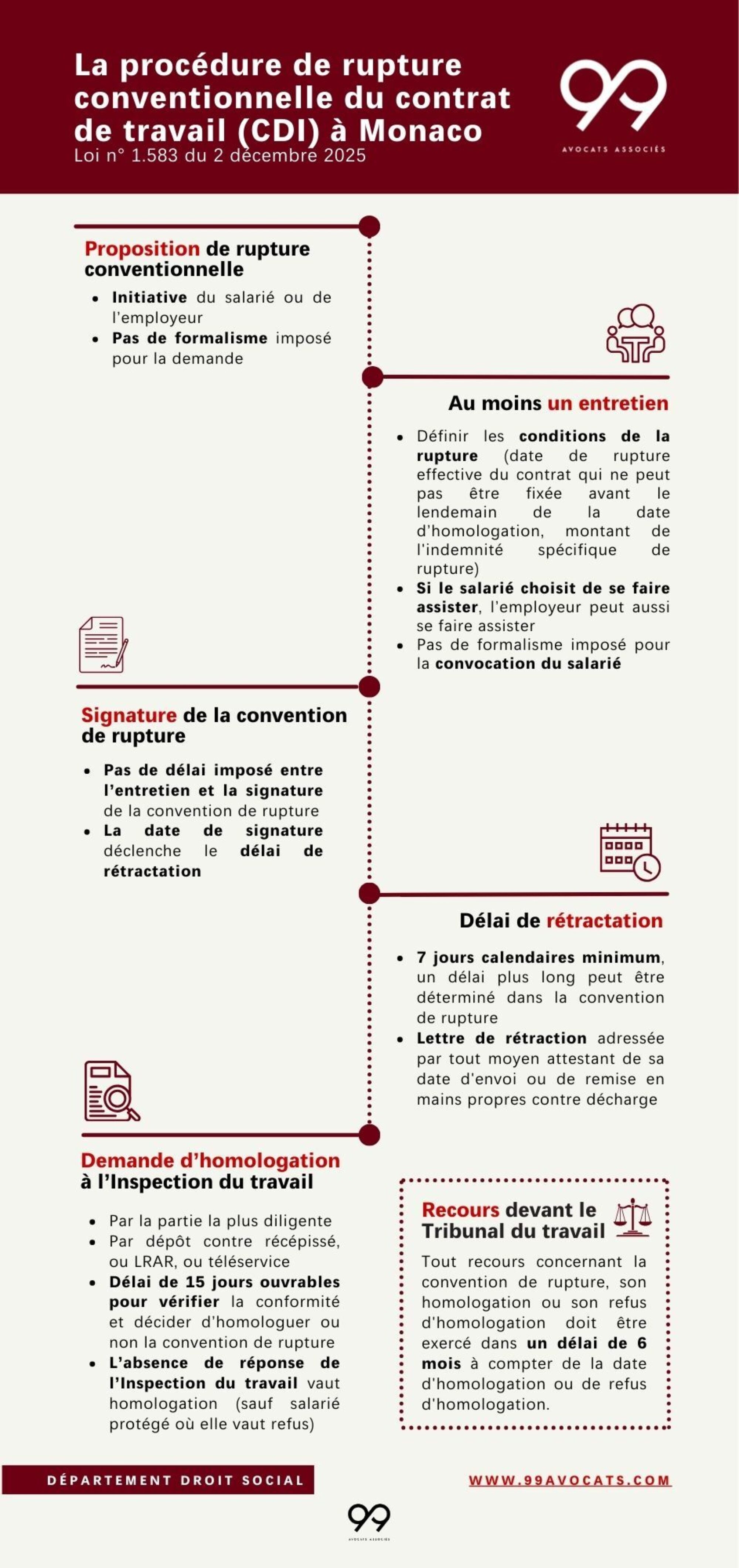
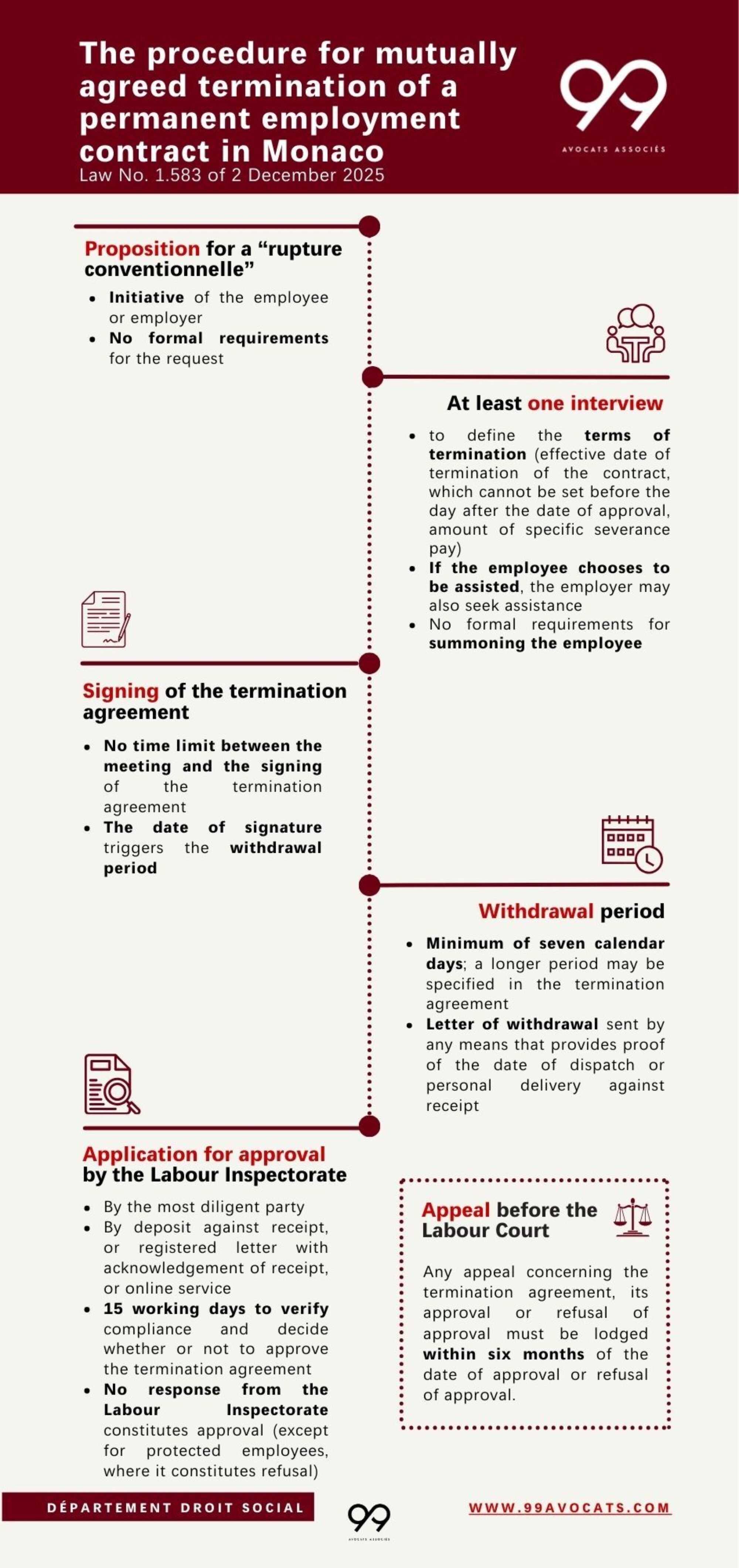
To provide a better understanding of this eagerly awaited scheme, the Employment Law Department at 99 AVOCATS ASSOCIÉS has produced an infographic outlining the key stages of the procedure, and presents the essentials of Monegasque consensual termination scheme (download the PDF version):
Key points on consensual termination
- Law No. 1.583 of 2 December 2025 introduced the mutually agreed termination of permanent employment contracts (CDI) in Monaco.
- Mutually agreed termination has been applicable since 13 March 2026 to existing CDIs and those entered into after that date.
- It allows the employer and the employee to terminate the CDI by mutual agreement under the conditions and in accordance with the procedure laid down by the Law.
- It entitles the employee to a specific severance payment and to the return-to-work allowance
Features of the consensual termination
- Principle: the employer and the employee mutually agree on the terms of the termination of the permanent contract by entering into a written termination agreement in accordance with the provisions of Law No. 1.583.
- The termination agreement is reviewed and approved by the Labour Inspectorate.
- Freedom of consent: the termination cannot be imposed on the other party, otherwise it will be null and void or reclassified (dismissal, resignation).
- Termination by mutual agreement cannot be prohibited by a collective agreement. Any clause to the contrary shall be deemed null and void.
Parties to the consensual termination
- Law No. 1.583 applies to employers in the private sector and to employees on permanent contracts (CDI).
- A mutual termination agreement cannot be entered into with an employee on a permanent contract who is currently on a probationary period.
- It may be agreed with a protected employee (staff representative, trade union representative, harassment officer).
- Law No. 1.583 does not prohibit it with an employee during a period of suspension of the employment contract (e.g. due to illness, an accident at work, or maternity leave).
The stages of a consensual termination
- The procedure begins with one or more meetings to allow the parties to discuss the principle and terms of the termination of the permanent contract.
- If an agreement is reached, a written agreement is drawn up in accordance with the template annexed to Ministerial Order No. 2025-715 of 24 December 2025.
- The parties then have a cooling-off period of at least 7 calendar days to reconsider their decision.
- At the end of this period, the termination agreement may be submitted to the Labour Inspectorate for approval.
The request for a consensual termination
- A mutual termination agreement may be initiated by either the employer or the employee.
- Law No. 1.583 imposes no formal requirements regarding the request for a meeting or its organisation, with a view to agreeing on the principle and terms of the mutual termination agreement.
- The request may therefore be made verbally (in person, by telephone) or in writing (by post, email).
- The employer or the employee, as the case may be, is under no obligation to respond to the request for a mutual termination agreement.
Meeting(s) on consensual termination
- The terms and conditions of the termination of the contract must be discussed by the employer and the employee during at least one preliminary meeting; otherwise, the termination agreement is void.
- Assistance: during the meeting, the employee may be assisted by a representative. If this is the case, the employer may also be assisted by a representative. Law No. 1.583 sets out the persons who may be chosen.
- Before the meeting takes place, each party must inform the other of their intention to be assisted and of the identity of the person chosen, in writing and within the time limits required by Law No. 1.583. Failing this, the meeting must be postponed.
Contents of the termination agreement
- The termination agreement signed following the meeting(s) must be drawn up in accordance with the template published in Annex I of Ministerial Order No. 2025-715, and must include the following mandatory information:
- Employer and employee details (identity, contact details, length of service, remuneration, etc.);
- Conduct of the procedure (date of the meeting(s), with or without assistance);
- Terms of the termination (agreed conditions, amount of the specific compensation, date of termination which may not be set before the day following approval, expiry of the withdrawal period);
- Date, place, “Read and approved”, signature.
Any contractual provision contrary to Law No. 1.583, which is a matter of public policy, shall be deemed null and void.
Severance pay for consensual termination
- The amount of the specific severance payment due to the employee is freely negotiated with the employer, subject to the statutory minimum determined on the basis of length of service, as follows:
- < 2 years’ service: at least ¼ month’s salary per year; pro rata for incomplete years.
- ≥ 2 years’ service: at least the amount of the severance pay provided for in Article 1 of Law No. 845 (calculated in accordance with the French statutory redundancy pay).
- The employer must pay the employee the full amount within one month of the date of termination of the permanent contract.
Withdrawal after signing the agreement
- The withdrawal period (the end date of which must be specified in the termination agreement) is a minimum of 7 calendar days from the date of signature. The parties may agree on a longer period.
- The party withdrawing must inform the other party by any means that provides proof of the date of dispatch of the letter or of hand-delivery against a receipt. They are not required to give a reason.
- An employee who withdraws shall not be subject to disciplinary action or to any measure that adversely affects the course of their career.
Application for approval of the agreement
- Once the withdrawal period has expired, the employer or the employee must submit a request for approval to the Labour Inspectorate, failing which the request will be deemed inadmissible:
- by submitting it in person against a receipt at the Service’s secretariat, or by registered post with acknowledgement of receipt (in both cases, two original copies of the termination agreement must be submitted),
- or via the online service (in this case, one copy of the termination agreement must be submitted).
The application for approval may be submitted from the day after the end of the withdrawal period.
Approval of the termination agreement
- The Labour Inspectorate is responsible for verifying that the information contained in the termination agreement complies with Law No. 1.583, and for approving it.
- Production of documents: the Labour Inspector may request that the parties provide any document he or she deems relevant.
- Hearings: the labour inspector may (in the case of an unprotected employee) or must (in the case of a protected employee) hear the parties.
- The labour inspector may ask the parties to amend the termination agreement
Processing time
- From the date of receipt of the application for approval, the Labour Inspectorate has 15 working days to verify the validity of the termination agreement.
- Where both parties have submitted an application for approval, the 15-day period begins from the date of the first application.
- Suspension of the 15-day period: where the Labour Inspector requests documents (until they are received), conducts interviews with the parties (until they are completed), or requests amendments to the termination agreement (until the amended agreement is received).
Unprotected employee
- Where the employee does not have the status of a protected employee, the Labour Inspector may hear the parties during a meeting, either together or separately.
- The stamp affixed by the Labour Inspector to each copy of the termination agreement constitutes approval.
- Failure by the Labour Inspectorate to respond within the specified time limit also constitutes approval. The parties may obtain a certificate of implied approval.
- The Labour Inspector must give reasons for any decision to refuse approval.
Protected employee
- Where the employee has the status of a protected employee (staff representative, trade union representative, harassment officer), the Labour Inspector must systematically hear the parties during a meeting, either together or separately, within the timeframe they set.
- The stamp affixed by the labour inspector on each copy of the termination agreement constitutes approval.
- The labour inspector must give reasons for any decision to refuse approval.
- Failure by the Labour Inspectorate to respond by the end of the specified time limit shall be deemed a refusal of approval.
Challenging the consensual termination
- Any appeal concerning the termination agreement, its approval or the refusal to approve it must be brought before the Labour Court, to the exclusion of any other judicial or administrative proceedings.
- The approval of the termination agreement cannot be the subject of a dispute separate from that relating to the termination agreement itself.
- The appeal to the Labour Court must be lodged, on pain of inadmissibility, within six months of the date of approval or the date of refusal to approve the termination agreement.
Penalties provided for by Law No. 1.583
- Offences punishable by a fine of between €1,000 and €2,250:
- (Any party) Imposing, through fraud, violence, coercion or threats, the use of a contractual termination, or the use of terms or conditions included in the termination agreement, which are not prescribed by Law No. 1.583 or Ministerial Order No. 2025-715.
- (Employer) Failing to pay the employee the specific allowance within the prescribed time limit, or in full, or making its payment conditional upon its subsequent repayment.
- In the event of a repeat offence within the 12 months preceding the offence in question: the fine shall be doubled.
Key takeaways on consensual termination
- Unlike dismissal or resignation, which result from the decision of the employer or the employee respectively, the termination of a permanent contract by mutual agreement cannot be imposed.
- It does not require justification.
- The end date of the employment contract, following approval by the Labour Inspectorate, is freely negotiated by the parties.
- The procedure is relatively straightforward.
- The employee is entitled to a specific severance payment and to unemployment benefit.
This publication does not constitute legal advice.
Other publications